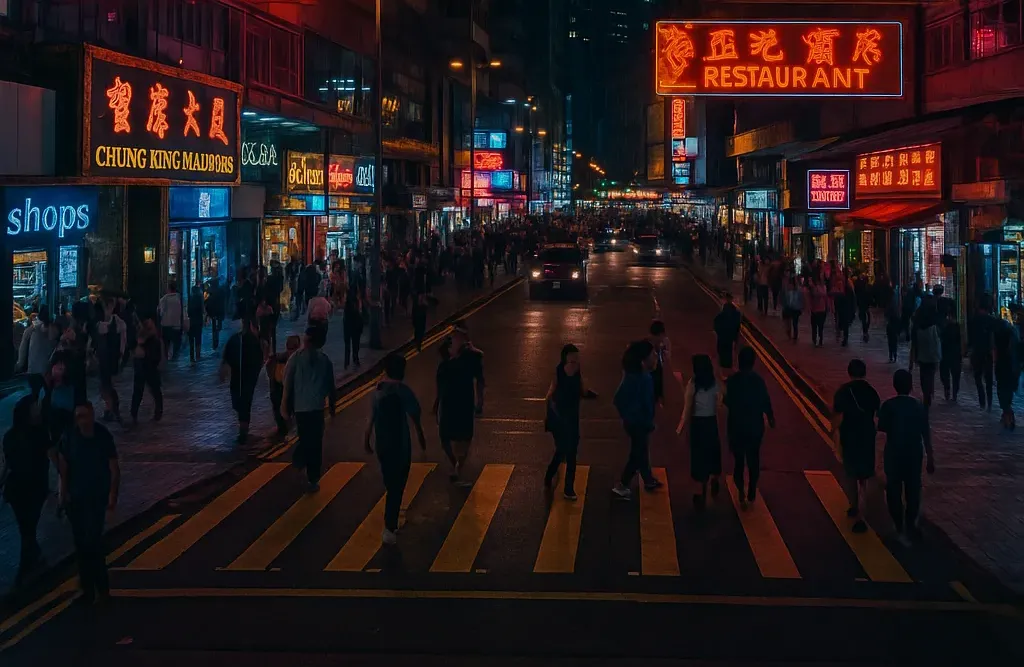
Hong Kong After Dark (and in the Day): Exploring a City of Contrasts
Hong Kong is a city that lives in dualities — glass towers rising above incense-filled alleys, neon light dancing on centuries-old stone, and ferries slicing through a harbor that has carried stories for generations. On my trip, I set out to experience both sides: the layered days that reveal the city’s texture, and the nights that reveal its moods through bars that are as much sanctuaries as they are social spaces.
By Day: Exploring the City’s Many Layers
My mornings began on the Harbourlink Ferry, a weathered green-and-white vessel that shuttles commuters across Victoria Sound. The ride was short, but it offered one of the most cinematic introductions to the city: skyscrapers rising like chrome blades from the water, framed by mist-covered mountains. It was a reminder that Hong Kong is not just vertical, but layered in every direction.
From the pier, I wandered into Silver Fish Market in Kowloon, a neighborhood-sized aquarium of commerce. Dozens of neon-lit stalls lined the streets, each displaying rows of plastic bags filled with live fish. The air buzzed with the whir of pumps and the calls of shopkeepers. It was surreal — more art installation than marketplace — and it showed me how ordinary trade can take on a dreamlike quality here.
Not far away was the Red Lantern Bazaar, a sprawling canopy of fabric awnings where vendors sold lacquered fans, herbal remedies, paper lanterns, and embroidered slippers. The entire street smelled of roasted chestnuts and five-spice duck, while fortune-tellers beckoned from tiny booths. I bought nothing, but I carried away the sensory memory of colors and voices colliding in a living mural.
One afternoon I boarded the Dragon’s Spine Tramway, a steep funicular that clattered up to Sky Summit, the city’s highest vantage point. The climb itself was the experience: the tram tilting at improbable angles as the buildings slid away, replaced by forested slopes and glimpses of outlying islands. At the top, the panorama of Victoria Sound was staggering — skyscrapers below like circuit boards, freighters gliding like steel insects across the water. As the sun set, the entire harbor seemed to ignite in gold, and for a moment it felt as if the city itself was exhaling light.
On another day, I visited the Temple of Ten Thousand Coils, tucked into the edge of the Central district. The temple was dim, lit only by shafts of daylight and the glow of incense spirals suspended overhead. Each coil burned slowly, some for days at a time, filling the air with a dense, sweet smoke. Locals wrote wishes on red slips of paper and tied them to the coils, watching as the smoke carried them skyward. Standing there, surrounded by incense and stone carvings, I felt the weight of continuity in a city that often feels like it’s sprinting into the future.
In the evenings before heading to the bars, I strolled the Night Blossom Promenade, a harborside walkway where street performers, food stalls, and pop-up art exhibitions created an ever-changing festival atmosphere. Children chased glowing kites, while musicians played erhu against a backdrop of neon ferries sliding past. It was the perfect threshold between day and night.
By Night: Bars That Defined the Atmosphere
When the sun finally dropped behind the skyline and the city’s neon blinked to life, I stepped into Hong Kong’s other identity — a world of bars that embody its moods and contradictions.
The Jade Lantern – Wan Chai
In a restored townhouse on a side street of Wan Chai, The Jade Lantern glowed from within like a secret waiting to be found. The décor was a balance of elegance and nostalgia: emerald glass lamps casting soft halos, carved wooden panels salvaged from old teahouses, and wide windows overlooking the tram lines below. The atmosphere was gentle but alive, a place where the hum of the city became background music to conversation. The appeal wasn’t spectacle, but comfort — the sense that you were connected to the city’s history simply by sitting there.
Temple & Smoke – Central
If The Jade Lantern grounded me, Temple & Smoke transported me. Tucked behind an unmarked door in Central, this speakeasy was built to feel like a shrine. Bronze incense burners lined the bar, releasing threads of sandalwood that mingled with candlelight. Thousands of miniature glass bottles hung from the ceiling, each glowing faintly, creating the sense of being under a constellation. Live music — often jazz, sometimes traditional Chinese strings — echoed in the haze. The effect was hypnotic. Hours slipped by inside Temple & Smoke, and stepping back onto the crowded street felt like waking from a dream.
Harbour’s Edge – West Kowloon
If the first two bars leaned inward — into history, memory, and myth — Harbour’s Edge exploded outward. Perched atop a steel-and-glass tower in Kowloon, it was a bar designed to impress. Floor-to-ceiling windows revealed the harbor from 80 stories up, a living map of ferries, bridges, and neon streaks. Inside, cobalt lighting and angular décor created a futuristic sheen, as if you were drinking inside a spaceship hovering over the city. Harbour’s Edge wasn’t intimate; it was monumental. The appeal was spectacle itself — being lifted above the noise, suspended between city and sky.
Closing Thoughts
What made Hong Kong unforgettable wasn’t just the places I saw, but how seamlessly they linked together. By day, the Harbourlink Ferry, Silver Fish Market, Dragon’s Spine Tramway, and Temple of Ten Thousand Coils revealed a city of traditions, rituals, and sensory collisions. By night, The Jade Lantern, Temple & Smoke, and Harbour’s Edge revealed a city of moods — grounding, dreamlike, and spectacular all at once.
The same paradoxes that shape Hong Kong’s skyline — ancient and modern, smoky and neon, grounded and aspirational — shape its nightlife as well. To experience both is to understand the city not as a destination, but as a living rhythm.
Hong Kong is less a place you visit than a pulse you join, if only for a while.